

Batch 6
Data Science and AI Programme
- Learn from leading VIT Bangalore faculty
- Learn industry-relevant Data Science tools
- Application-based learning with Capstone Project
- Deep dive into ML Algorithms
- Learn GenAI's practical applications with case studies
Batch Closing Soon: Secure Enrolment Benefit of Flat ₹7,500 by Invalid liquid data
The application deadline ends on: Invalid liquid data
Integrated with Generative AI
Meet Your Faculty: Dr Pitchumani Angayarkanni S
Data Science and AI Programme at VIT Bangalore
Step into the future with VIT Bangalore’s Certificate in Data Science and AI, a 16-week online programme designed for aspiring data scientists and AI professionals. Learn Python for data science, master essential tools like Pandas, Matplotlib, and explore Generative AI through hands-on projects and live sessions.
With India’s data science industry projected to reach $16 billion by 2025 and over 11 million jobs expected in AI and ML domains, this programme equips you with the skills to thrive in a high-growth career. Whether you're a beginner or a mid-level professional, you’ll gain practical expertise in machine learning, data visualisation, and AI-powered analytics, all guided by expert faculty from VIT Bangalore, and become part of India’s AI revolution.
Why Choose a Career in Data Science?
$16B
36%
$200B
₹11.5 lakh
Programme Highlights

Gain insights from VITB's expert faculty in Data Science, ML & AI with recorded sessions and an industry-tailored curriculum.

Hands-on Jupyter Notebook exercises and real-world case studies for Python-based data science exploration.

Emphasis on ML with dedicated modules covering classification, regression, and clustering techniques.

In-depth exploration of ML algorithms, including supervised and unsupervised learning, and time series analysis.

Receive a certificate of completion from VITB and excel in your career.

Delve into each module, which underscores the practical application of concepts, preparing you to solve real-world problems across industries.

Gain practical insights from programme leaders. Master data science & AI through real-world case studies and hands-on exercises.

Unleash the power of AI for creative tasks. Explore cutting-edge techniques in our Generative AI Masterclasses and unlock potential for text and image generation
Note: Confirmation of the final number of quizzes, assignments and discussions will occur closer to the commencement of the programme.
Key Highlights
80+
7+
10+
25+
8+
Emeritus Career Services

15 Recorded Sessions and Resources in the Following Categories (Please note: These sessions are not live):
Resume & Cover Letter
Navigating
Job Search
Interview Preparation
LinkedIn Profile Optimisation
Note:
VITB or Emeritus do NOT promise or guarantee a job or progression in your current job. Career Services is only offered as a service that empowers you to manage your career proactively. The Career Services mentioned here are offered by Emeritus. VITB is NOT involved in any way and makes no commitments regarding the Career Services mentioned here. This service is available only for Indian residents enrolled into select Emeritus programmes.
This service is available only for Indian residents enrolled into select Emeritus programmes.
Enhance Your Skills with AI Masterclasses

Python Functions and Data Science Packages
Write Python functions and explore powerful packages like NumPy, Pandas, and Matplotlib.

Data Analysis and Data Visualisation
Work on real-world case studies, using Pandas for data exploration and creating visualisations with Matplotlib & Seaborn.

Real-World Data Cleaning Challenges
Tackle common data cleaning tasks: handling missing data, correcting data types, managing outliers, and normalisation.

Exploratory Data Analysis and Linear Algebra
Master EDA and understand key linear algebra concepts essential for machine learning.
Who is this programme for?
Early professionals who want an understanding of Python and data science and foundational knowledge of ML, GenAI and its applications
Mid-managers who want to learn the concepts of Python and how to use it data science, machine learning and GenAI projects
Learner Testimonial

Tools Covered
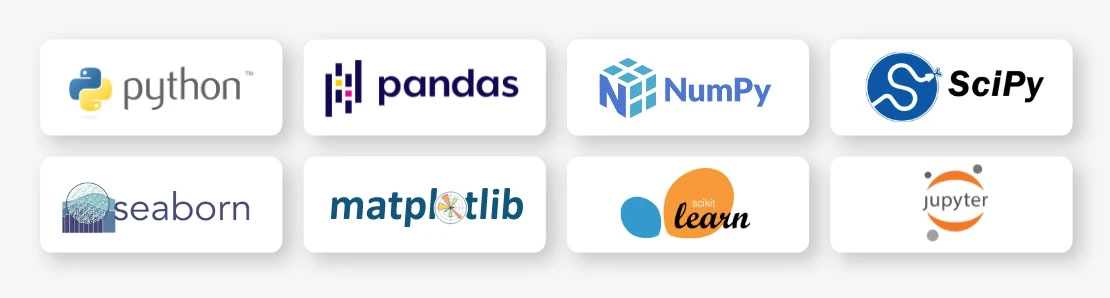
Note: All product and company names are trademarks or registered trademarks of their respective holders. Use of them does not imply any affiliation with or endorsement by them.
The tools mentioned are subject to change and will be finalised prior to the start of the programme
Programme Modules
Module 1: Introduction to Data Science
Why learn Data Science?
What is Data Science?
Essential Data Science Tools
The Data Science Lifecycle
Adopting a Data Scientist's Mindset
Core Principles: Collaboration, Reproducibility and Ethics
Module 2: Working with Data Types and Operators in Python
Introduction to Python
Running Jupyter Notebooks
How to Use a Jupyter Notebook
Basic Data Types
Comparison and Logical Operators
Lists and Indexing
Advanced Indexing
Updating Data in a List
Introduction to Tuples
Introduction to Dictionaries in Python
Module 3: Writing Functions in Python
Functions and Arguments
Methods
Writing User-Defined Functions
Conditionals: If Statements
Conditionals: While Loops
For Loops
Looping through a Dictionary
Module 4: Popular Data Science Packages in Python
Packages
NumPy Arrays
2D NumPy Arrays
Looping over NumPy Arrays
Pandas Creating Data Frames
Pandas Slicing and Filtering Data Frames
NumPy and Pandas Statistical Tools
Module 5: Advanced Functions
Functions
Global Scope vs Local Scope
Nested Functions
Default and Flexible Arguments
Handling Errors and Exceptions
Writing Lambda Functions
Module 6: Data Manipulation and Analysis with Pandas
Importing and Exporting Data
Series
Data Frames
Common Functionality
Indexing and Selecting Data
Editing Data Frames: Setting Columns
Editing Data Frames: Transforming Columns
Editing Data Frames: Setting Data with loc
Combining Data Frames
Reshaping Data Frames
Grouping and Aggregating Data
Module 7: Data Visualisation with Matplotlib
Introduction to Matplotlib
Simple Line Plots
Bar Plots
Scatter Plots
Histograms
Customising Graphs
Line of Best Fit
Box Plots
Pair Plots
Time Series Plots
Introduction to 3D Plotting
Exporting Figures
Module 8: Random Variables and Statistical Inferences
Probability and Statistics
Probability vs Statistics in Python
Sampling Using Python
Random Variables and Probability Distribution Functions
Random Variables and Probability Distribution Functions in Python
Probability Mass and Probability Density Functions
Module 9: Statistical Distributions and Hypothesis Testing
Uniform Distribution
Bernoulli and Binomial Distributions
Normal Distribution
Exponential, Poisson and T Distributions
Confidence Intervals
Hypothesis Testing
Hypothesis Testing: Confidence Intervals for Difference in Means
Module 10: Data Cleaning
The Data Cleaning Process
Inspecting the data
Strategies for data cleaning
Dealing with missing or duplicate data
Module 11: Exploratory Data Analysis
Introduction to Exploratory Data Analysis
Descriptives, Frequencies and Averages
Correlation
Visualising and Plotting Data in Exploratory Analysis
Data Preprocessing
Module 12: Getting Started with Linear Algebra for Machine Learning
Introduction to Linear Algebra
Matrices and Vectors
Matrix Addition and Subtraction
Dot Product and Cross Product
Matrix Multiplication and Division
Matrix Transposition
Matrix Determinant and Inverse
Cumulative Distribution Function
Span and Linear Independence
Eigenvalues and Eigenvectors
Singular Value Decomposition
Principal Component Analysis
Maximum Likelihood Estimation
Module 13: Intro to Machine Learning and Python Libraries
What is machine learning?
Types of machine learning (supervised, unsupervisedand reinforcement learning)
Applications of machine learning in various industries
Deep Learning
Intro to NLP and Time Series Analysis
Module 14: Supervised Learning: Classification and Regression
Linear regression
Logistic regression
Decision trees and random forests
Support vector machines
Naive Bayes classifiers
Module 15: Random Forest with Python, KNN with Python
What is a Random Forest?
How Random Forests build multiple decision trees
Handling missing data and outliers
Using scikit-learn to create a Random Forest classifier
Hyperparameter tuning, including the number of trees and maximum depth
Feature selection and importance
K-fold cross-validation for assessing Random Forest performance
Evaluation metrics like accuracy, precision, recall, F1-score, and ROC curves
Basic principles and intuition behind KNN
How KNN makes predictions based on nearest neighbours
Different distance metrics like Euclidean, Manhattan, and others
Using scikit-learn to create a KNN classifier
Choosing the value of 'k' and its impact on the model
Evaluating KNN performance with cross-validation
Selecting the right evaluation metrics for classification problems
Module 16: Unsupervised Learning
What is unsupervised learning, and how is it different from supervised learning?
K-Means Clustering
Hierarchical Clustering
Density-Based Clustering (DBSCAN)
Evaluating clustering quality (e.g.Silhouette Score)
Dimensionality reduction
Anomaly detection
Association rule mining
Recommendation systems
Metrics for assessing the quality of unsupervised learning results
Discuss practical applications in fields like finance, healthcare,marketing etc
Note: The sequence of modules is subject to change and the final schedule will be shared during the orientation session.
Module numbers 5, 7, 10, 12, 14, and 15 include live sessions led by the programme leader.
Explore the 16-Week Artificial Intelligence and Machine Learning Programme by VIT Bangalore.
Generative AI Modules
Module 1: Foundations of Generative AI
Foundational Concepts: Learn the basics of generative AI, including key concepts and applications.
Generative Models: Understand Generative Adversarial Networks (GANs) and Variational Autoencoders (VAEs).
Model Applications: Gain insights into how these models work and where are they used.
Module 2: Implementing Generative Models with Python
Hands-on Implementation: Participants will engage in practical implementation of basic generative models using Python libraries.
Step-by-Step Tutorials: Follow detailed tutorials to create generative models for image and text generation.
Practical Exercises: Reinforce understanding through hands-on exercises and real-world applications.
Module 3: Practical Applications of Generative AI in Data Science
Introduction to Applications: Discover practical applications of generative AI in data science.
Data Augmentation: Explore how generative models enhance datasets for machine learning tasks.
Case Studies: Understand the impact of data augmentation on model performance in image classification and text analysis through real-world examples.
Module 4: Creating Synthetic Data with Generative AI
Synthetic Datasets: Learn to create synthetic datasets using generative models.
Applications: Generate synthetic data for filling in missing data and balancing imbalanced datasets.
Real-World Examples: See how synthetic data improves model training and evaluation through practical examples.
Prestigious Leadership Team

Dr. V Raju
Former Vice Chancellor, Vellore Institute of Technology

Prof. Prema M
Director, International Center for Education and Research (ICER)
Renowned Faculty Experts

Dr Pitchumani Angayarkanni S
Professor | Specialisations: Computer Vision, Machine Learning and Deep Learning

Dr. Shiyamala Gowri
Associate Professor | Specialisation: Data Science

Ramya Mohankrishnan
Assistant Professor | Specialisation: Deep Learning
Programme Certificate
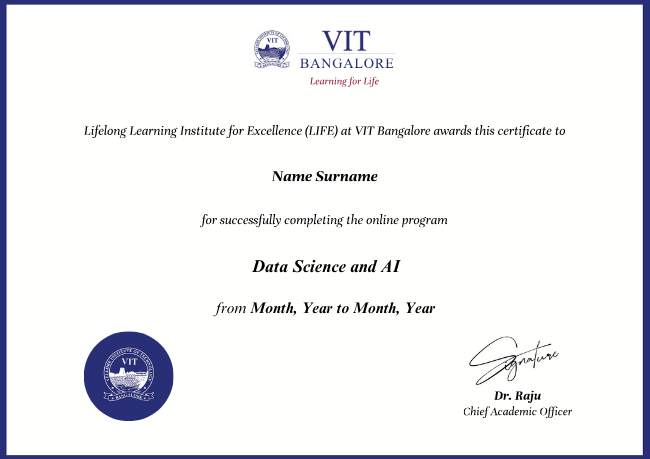
Participants will receive a VIT Bangalore certificate upon successful completion of the programme.
VIT Bangalore will award a certificate of successful completion to participants who complete the programme successfully with 70% of the score in the evaluation.
Note: All certificate images are for illustrative purposes only and may be subject to change at the discretion of VIT Bangalore.
Explore the 16-Week Artificial Intelligence and Machine Learning Programme by VIT Bangalore.
FAQs
What is the VIT Data Science and AI Certificate programme?
The VIT Data Science and AI Certificate Programme is an online course offering a strong foundation in data science, AI, and machine learning. It includes practical projects using Python for data science and covers key topics like data analytics, machine learning training, and AI applications. Ideal for beginners and professionals alike, this data science certification course equips learners with industry-relevant skills for career growth.
What is the scope of this data science programme in India?
The scope of the VIT Data Science and AI course in India is vast, with growing demand for experts in data science, AI, and machine learning across industries. This data science certification course equips you with practical skills in Python for data science, analytics, and AI applications, opening doors to diverse career opportunities in technology, finance, healthcare, and more.
What is the mode of this programme?
This 16-week online data science and AI course by VIT is delivered through recorded sessions, offering flexibility for working professionals to learn at their own pace. The programme includes data science online classes, practical projects, and Python-based machine learning training, making it ideal for career-focused learners.
Who should apply for this online data science programme?
This data science online programme is ideal for professionals who want to gain or enhance their skills in Python, data science, machine learning, and Generative AI. Whether you're an early-career professional or a mid-level manager, this course offers valuable insights and practical applications in data science and AI. If you still have questions on whether this programme is a good fit for you, please email support.india@emeritus.org, and a dedicated programme advisor will follow-up with you very shortly.
What are the tools covered in this data science online programme?
This data science programme covers Python, Pandas, Matplotlib, Seaborn, NumPy, and Jupyter Notebook.
Early registrations are encouraged. Seats fill up quickly!
Flexible payment options available.
Programme Starts On