

Batch 5
Certificate in Artificial Intelligence and Machine Learning
- Live Sessions with VIT Faculty and Industry Experts
- Master Generative AI Applications and Explore ML Algorithms
- Gain Hands-On Experience with Industry relevant Tools and Capstone Project
- In-Depth Modules on Machine Learning
Invalid liquid data
Master GenAI: Build, Apply and Innovate

Develop an AI-First Approach and Achieve Transformative Growth
$1trillion
75%
40%
Master AI and ML for Business Excellence
The Certificate Programme in Artificial Intelligence and Machine Learning equips you with essential skills to excel in AI. You'll explore core AI and ML principles, delve into the revolutionary impact of Generative AI across industries, and develop leadership capabilities to drive innovation and success in today's dynamic landscape. Immerse yourself in Generative AI's transformative potential, gaining hands-on experience that advances your career in the rapidly evolving AI world.
Programme Highlights

Live sessions by the prestigious and renowned VIT Bangalore faculty and industry experts

Integrate AI into your business processes through hands-on learning with capstone project, practical assignments and interactive quizzes

A Python primer for an introduction to Python and its libraries

Delve into Generative AI to solve complex business problems and apply innovation

8+ Industry-Relevant Tools and Python Libraries

Earn a Certificate of Completion from VIT Bangalore and stand out to employers
Note:
The programme highlights presented above are approximate, and subject to change depending on the availability and expertise of the teaching faculty, as well as the programme's desired outcomes.
The primary mode of learning for this programme is via live online sessions with faculty members. Post-session video recordings will be made available, at the discretion of faculty members.
Who Is This Programme For?
This programme is ideal for tech professionals who want to build AI/ML foundations, understand its applications and lead AI projects using emerging tech like Generative AI.
Professional upskilling for tech experts
Individuals in data or tech roles, aiming to use AI and ML to enhance business value and communication with non-technical managers
Cross-industry transition
Individuals who aim to grasp foundational AI concepts and industry tools to facilitate a transition into a new role with enhanced salary prospects
Prestigious Leadership Team

Dr. V Raju
Former Vice Chancellor, Vellore Institute of Technology

Prof. Prema M
Director, International Center for Education and Research (ICER)
Renowned Faculty Experts From VIT Bangalore

Dr. Pitchumani Angayarkanni
Professor, Specialisations: Computer Vision, Machine Learning and Deep Learning

Dr. Shiyamala Gowri
Associate Professor

Ramya Mohankrishnan
Assistant Professor
Tools, Languages & Libraries Covered
Note: All product and company names are trademarks or registered trademarks of their respective holders. Use of them does not imply any affiliation with or endorsement by them.
Programme Modules
Week 1: Introduction to AI and ML
History and Evolution of AI: Overview of AI development from its inception to present day
Key Concepts and Terminology: Definitions of AI, ML, Deep Learning, and related terms
Applications of AI: Real-world applications in various fields like healthcare, finance, and autonomous systems
Week 2: Python for AI and ML
Python Basics and Control Structures
NumPy for Numerical Computations
Pandas for Data Manipulation
Data Visualisation with Matplotlib and Seaborn
Week 3: Data Preprocessing and Exploration
Data Cleaning: Handling missing values, outliers, and duplicates
Data Transformation: Scaling, normalisation, and encoding categorical variables
Exploratory Data Analysis (EDA): Visualisation techniques and summary statistics
Week 4: Supervised Learning - Regression
Linear Regression: Concepts, assumptions, and implementation
Evaluation Metrics: Mean Absolute Error, Mean Squared Error, and R-squared
Week 5: Supervised Learning - Classification
Logistic Regression: Binary classification, sigmoid function, and cost function
Evaluation Metrics: Accuracy, precision, recall, F1-score, and ROC-AUC
Week 6: Other Supervised Learning Algorithms
Decision Trees: Basics, advantages, and limitations.
k-Nearest Neighbors (k-NN): Concept and implementation.
Support Vector Machines (SVM): Basic understanding and applications.
Week 7: Model Evaluation and Optimisation
Model Validation Techniques: Cross-validation and train-test split.
Hyperparameter Tuning: Basics of grid search and random search.
Ensemble Methods: Introduction to bagging and boosting.
Week 8: Unsupervised Learning - Clustering
K-Means Clustering: Algorithm, choosing k, and evaluation.
Hierarchical Clustering: Basics and applications.
Week 9: Unsupervised Learning - Dimensionality Reduction
Principal Component Analysis (PCA): Concept and implementation.
t-Distributed Stochastic Neighbor Embedding (t-SNE): Basics and visualisation.
Week 10: Introduction to Neural Networks
Neural Networks Basics: Structure, activation functions, and forward propagation.
Training Neural Networks: Introduction to backpropagation and gradient descent.
Week 11: Deep Learning with Neural Networks
Deep Learning Frameworks: Introduction to TensorFlow and Keras.
Building Simple Neural Networks: Hands-on practice with basic neural networks.
Week 12: Introduction to Natural Language Processing (NLP)
Text Preprocessing: Tokenisation, stemming, lemmatisation
Basic NLP Models: Bag of Words and TF-IDF
Week 13: Introduction to Time Series Analysis
Basic Concepts: Time series data, trend, seasonality, and noise
Simple Models: Moving averages and exponential smoothing
Applications: Forecasting and anomaly detection in time series data
Week 14: Introduction to Recommender Systems
Basic Concepts: Overview of recommender systems and their importance
Collaborative Filtering: User-based and item-based collaborative filtering
Content-Based Filtering: Using item features for recommendations
Hybrid Methods: Combining collaborative and content-based approaches
Week 15A: Introduction to Generative AI
Introduction to Generative AI
Generative Models Overview
Generative Adversarial Networks (GANs)
Variational Autoencoders (VAEs)
Applications of Generative Models
Week 15B: Implementing Generative Models with Python
Setting Up the Environment - Installing necessary Python libraries (TensorFlow, Keras, PyTorch)
Implementing GANs
Implementing VAEs
Image Generation with GANs
Text Generation with VAEs
Week 16A: Practical Applications of Generative AI in Data Science
Introduction to Data Augmentation
Data Augmentation with GANs
Data Augmentation with VAEs
Case Studies - Real-world examples of data augmentation in image classification and text analysis
Impact of Data Augmentation
Week 16B: Creating Synthetic Data with Generative AI
Introduction to Synthetic Data
Generating Synthetic Data with GANs
Generating Synthetic Data with VAEs
Case studies on using synthetic data in healthcare, finance, and other industries
Best Practices and Considerations when using Synthetic data
Capstone Project: Development of a Predictive Analytics Model for Healthcare
Note:
Topics will be taught via live sessions by Emeritus industry experts and VIT Bangalore faculty.
For this programme, a foundational understanding of Python, coding, mathematics/statistics, and data science fundamentals is required.
Explore the 16-Week Data Science and AI Programme by VIT Bangalore.
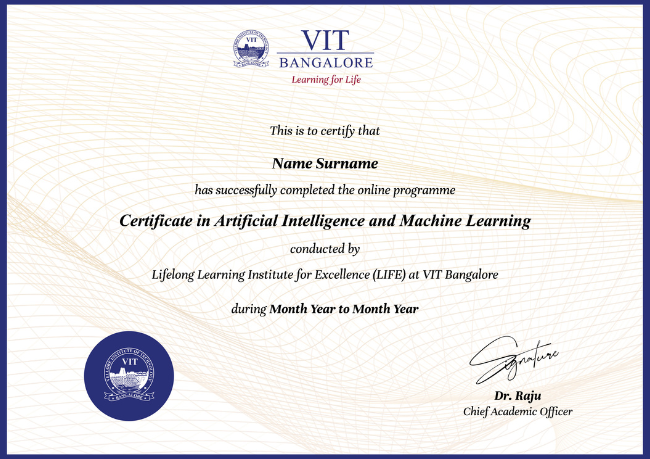
Programme Certificate
On successful completion of the programme, you will be awarded a certificate of successful completion from VIT Bangalore.
VIT Bangalore will award a certificate upon successful completion of the programme, subject to a minimum of 70% attendance and a minimum score of 60% in evaluations.
Note: All certificate images are for illustrative purposes only and may be subject to change at the discretion of VIT Bangalore.
Programme Takeaways

Master Python programming tailored for AI and ML applications.

Gain proficiency in data preprocessing and exploration techniques.

Implement and critically evaluate supervised learning algorithms for both regression and classification tasks.

Acquire insights into model evaluation, validation, and optimisation strategies.

Apply unsupervised learning techniques for clustering and dimensionality reduction.

Develop a deep understanding of Generative AI models and their implementation for data augmentation and synthetic data creation.
Emeritus Career Services

15 Recorded Sessions and Resources in the Following Categories (Please note: These sessions are not live):
Resume & Cover Letter
Navigating
Job Search
Interview Preparation
LinkedIn Profile Optimisation
Note:
VITB or Emeritus do NOT promise or guarantee a job or progression in your current job. Career Services is only offered as a service that empowers you to manage your career proactively. The Career Services mentioned here are offered by Emeritus. VITB is NOT involved in any way and makes no commitments regarding the Career Services mentioned here. This service is available only for Indian residents enrolled into select Emeritus programmes.
This service is available only for Indian residents enrolled into select Emeritus programmes.
Explore the 16-Week Data Science and AI Programme by VIT Bangalore.
FAQs
What is VIT’s Artificial Intelligence and Machine Learning Programme?
A 16-week AI and ML certification programme delivered live online, offering hands-on training in AI and ML, Python for machine learning, and Generative AI. Taught by VIT faculty and industry experts, this artificial intelligence and machine learning course equips learners with practical skills for real-world applications. Graduates receive a certificate from VIT Bangalore, one of the leading institutes offering AI courses in India.
What is the mode of this VIT AI and ML programme?
The programme is delivered in a live online format, featuring interactive sessions with VIT faculty and industry experts. Learners gain practical experience through one of the most engaging machine learning and artificial intelligence courses, working with Python for machine learning and exploring foundational topics like the introduction to artificial intelligence and machine learning. Hands-on projects and case studies ensure real-world skill development in this comprehensive AI and ML course online.
Does pursuing a career in Artificial Intelligence and Machine Learning offer promising future opportunities?
Yes, a career in artificial intelligence and machine learning offers immense potential. With the growing demand for professionals skilled in areas like machine learning using Python, individuals with the right expertise can secure high-paying roles across industries. Completing AI ML certification courses equips you with the technical and strategic capabilities needed to thrive in the evolving tech landscape and explore leadership positions in AI-driven fields.
Who should apply for this AIML Programme?
This artificial intelligence and machine learning programme is ideal for tech professionals, data scientists, and aspiring AI leaders seeking to enhance their skills. It's also suitable for those aiming to transition into AI-focused roles or learn advanced concepts like machine intelligence and Python for machine learning.
What are the tools covered in this AIML online programme?
This artificial intelligence and machine learning course covers Python, Pandas, Matplotlib, Seaborn, NumPy, and Jupyter Notebook.
Early registrations are encouraged. Seats fill up quickly!
Flexible payment options available.
Programme Starts On